Nine UNESCO World Heritage sites in Thailand
Thailand offers far more than lively markets and delicious food. Travel beyond the usual routes and you will find centuries-old capitals, archaeological treasures and forests that shelter remarkable wildlife.
As of October 2026, Thailand has nine UNESCO World Heritage inscriptions: six cultural and three natural sites. The newest inscription, Wat Phra Mahathat Woramahawihan in Nakhon Si Thammarat, was added in 2026.
This guide introduces what makes each site special and offers practical pointers for planning a visit. Some protected natural areas have restricted access, so always check the rules before traveling.
Photographs illustrate representative places or features associated with each site. For large natural sites, a map pin is only an approximate reference point, not the boundary of the protected area. Maps and remote photos require an internet connection. See UNESCO World Heritage Centre’s official list for Thailand.
📍 How to use this guide: locate each site on the overview map, explore the photos and background, then use the Google Maps links in each section to plan your visit.
Where are Thailand’s World Heritage sites?
Use this illustrated overview to see where the nine sites lie. Tap a number or the name in the list to jump to its section. Pins represent approximate locations, not official property boundaries.
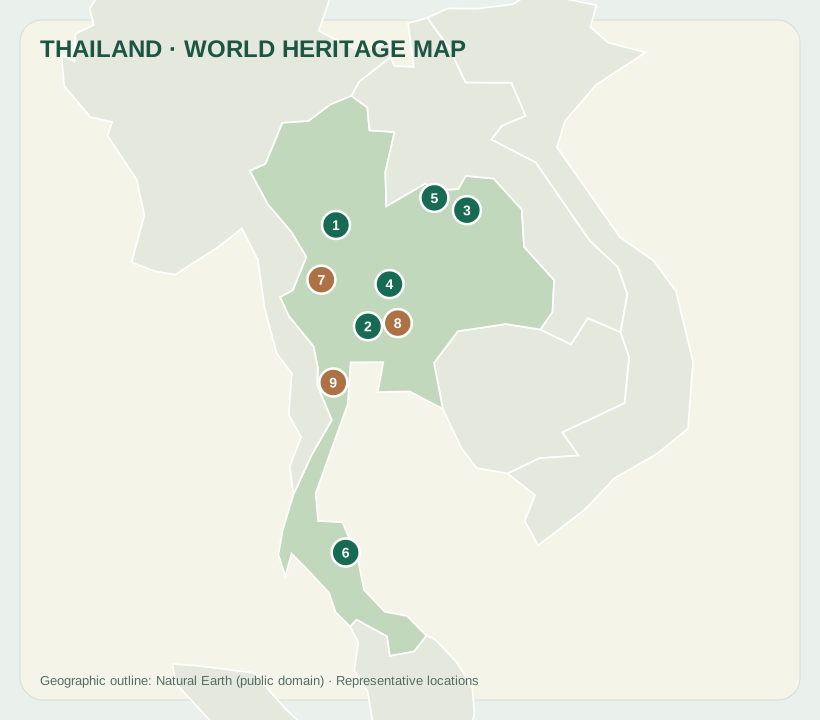
Illustrated schematic by thailand.hub. Locations are approximate; the outline, distances and scale are not suitable for navigation. Numbers identify representative areas, not UNESCO boundaries.
1. Historic Town of Sukhothai and Associated Historic Towns

Where Thai cultural history took shape
Sukhothai flourished in the 13th century and is often described as the capital of one of the earliest major Thai kingdoms. At Wat Mahathat, look for lotus-bud-shaped stupas; at Wat Si Chum, an immense seated Buddha is the highlight.
Sukhothai is traditionally associated with the origins of the Loy Krathong festival, although its exact origins are debated. King Ramkhamhaeng is also credited by tradition with creating Thai script; the historical details remain a subject of scholarship, and the script evolved over time.
The World Heritage property covers three towns: Sukhothai, Si Satchanalai and Kamphaeng Phet. Si Satchanalai was a major centre of ceramic production. Its Sangkhalok wares reached Japan, where ceramics known as Sunkoroku were appreciated in tea culture, including during the Edo period. Kamphaeng Phet is notable for its walls and laterite ruins.
Visiting tip: Bicycles are easy to rent around Sukhothai Historical Park and are a practical way to explore. Carry water and avoid the hottest hours. The three historic towns are far apart, so allow extra travel time.
2. Historic City of Ayutthaya

An international capital built around rivers
Founded around 1350, Ayutthaya became a flourishing Siamese capital. Its position between three rivers supported trade and diplomacy with visitors from across Asia and Europe.
Do not miss the three stupas of Wat Phra Si Sanphet and the Buddha head entwined in tree roots at Wat Mahathat. Wat Chaiwatthanaram is also beautiful at sunset, although individual attractions do not necessarily fall within the World Heritage boundary.
The city also has a connection to Japan: a Japanese settlement flourished here in the 17th century. Visiting the Japanese Village site adds another dimension to the story of international exchange.
Visiting tip: Ayutthaya can be visited from Bangkok in a day, but the ruins are spread out. Combine a bicycle or local transport with breaks in the shade.
3. Ban Chiang Archaeological Site

Prehistoric lives revealed through pottery
Ban Chiang is an important archaeological site for understanding early farming communities, metalworking and burial practices in Southeast Asia. Excavations have uncovered pottery, bronze objects and ornaments.
The red-painted pottery with swirling patterns is instantly recognizable. More revealing still are displays showing how objects were found in graves and settlement layers. Dating interpretations have changed with new research, so claims that this is the world’s oldest bronze site should be treated cautiously.
Visit the Ban Chiang National Museum alongside accessible excavation displays to see how archaeologists reconstruct everyday life.
Visiting tip: Udon Thani is a useful base; arrange transport and check museum opening hours in advance.
4. The Ancient Town of Si Thep and its Associated Dvaravati Monuments

A walled ancient city and monumental remains
Si Thep preserves the urban landscape of the Dvaravati period, especially its distinctive inner and outer towns surrounded by moats.
The vast Khao Klang Nok monument and Khao Thamorrat Cave are key parts of the World Heritage property. Together they show how influences from India were adapted into a distinctive regional artistic tradition.
Take time to understand the layout of the historic city, and consider the related monuments if access and time allow.
Visiting tip: A car is useful for reaching this part of southern Phetchabun. Bring water and sun protection.
5. Phu Phrabat, a testimony to the Sema Stone tradition of the Dvaravati period

Unusual rock formations and sacred boundary stones
Phu Phrabat is known for its striking rock shelters and balancing-looking boulders. Ho Nang Usa is one of its best-known formations.
The World Heritage significance lies especially in the Sima stones placed here during the Dvaravati period, marking sacred Buddhist areas. Their relationship with the natural rock formations makes the landscape exceptional.
Ancient paintings in rock shelters show that people valued this place long before the Dvaravati period. Look beyond the dramatic rocks to the boundary stones and painted surfaces.
Visiting tip: Wear shoes with good grip and take care on wet rock surfaces. Check access arrangements before travelling.
6. Wat Phra Mahathat Woramahawihan

A living heritage shaped by maritime exchange
Inscribed in 2026, Wat Phra Mahathat in Nakhon Si Thammarat has a history reaching back to the eighth century. Maritime trade brought artistic and religious influences from across South and Southeast Asia.
The white Great Reliquary stupa is the centrepiece. Its architecture reflects a blending of regional traditions, including Sri Lankan influences.
This is not simply an archaeological monument: ceremonies, local traditions and the Nora performing arts remain part of the surrounding cultural life.
Visiting tip: The temple is in the city. Dress respectfully and follow local rules for photography and worship areas.
7. Thungyai–Huai Kha Khaeng Wildlife Sanctuaries

A vast refuge for wildlife
Thungyai and Huai Kha Khaeng protect one of mainland Southeast Asia’s largest expanses of relatively undisturbed forest. Elephants, tigers and many other species depend on its connected habitats.
Its importance is not that wildlife is easy to spot, but that animals can survive in a large protected landscape. Learning about conservationist Seub Nakhasathien also helps explain the site’s legacy.
Appropriate visitor experiences focus on permitted nature-education facilities, conservation exhibits and forest scenery, not searching for tigers or elephants.
Visiting tip: Much of the sanctuaries is closed to casual tourism. Check approved visitor areas with the authorities and never enter restricted zones.
8. Dong Phayayen–Khao Yai Forest Complex

Waterfalls and the sounds of a living forest
The Dong Phayayen–Khao Yai Forest Complex links protected forests across roughly 230 kilometres, supporting the movement of wildlife.
At the accessible Khao Yai National Park, Haew Suwat and Haew Narok waterfalls are memorable highlights. Forest walks offer chances to notice birds, plants and sometimes deer or monkeys.
Elephants, gibbons and many threatened species live in this wider forest complex, although sightings are never guaranteed. Listening to the forest can be as rewarding as spotting animals.
Visiting tip: Pak Chong is a common base. Never feed wildlife and check trail and waterfall access, which can change with weather.
9. Kaeng Krachan Forest Complex

Misty mountain scenery and outstanding birdlife
Kaeng Krachan protects a vast mountain forest at a meeting point of different ecological regions. It supports elephants, banteng and rare wild cats, among many other species.
The Panoen Thung area is known for mountain scenery and, when conditions align, seas of mist. Birdwatchers are drawn to the forest’s rich birdlife, while butterflies and forest sounds add to the experience.
The World Heritage value goes beyond scenic viewpoints: these forests provide vital habitat for exceptional biodiversity.
Visiting tip: Check park notices before travelling. Roads toward Panoen Thung may be restricted by season, vehicle requirements or conservation measures.
How to plan your World Heritage trip
For history lovers: Ayutthaya is accessible from Bangkok, while Sukhothai and its associated towns reward a longer journey north. Give yourself time to explore rather than rushing between monuments.
For less-visited archaeology: Consider Ban Chiang, Si Thep and Phu Phrabat. These sites may require more road travel, so a nearby city can make a convenient overnight base.
For nature: Look into visitor-accessible parts of Khao Yai and Kaeng Krachan. Wildlife encounters are never guaranteed, and conservation rules must be respected.
Before you go
Opening days, entrance fees, transport options and weather-related restrictions can change. Consult the relevant heritage site or national park authority before departure. Respect fragile monuments and minimize disturbance to wildlife and habitats.
A different side of Thailand
From quiet ruins to remarkable forests, Thailand’s World Heritage sites offer very different experiences. Choose one that captures your curiosity and let it introduce you to another side of the country.
Source: UNESCO World Heritage Centre – Thailand (consulted October 2026).